A daily record of progressive & regressive eye conditions.
Eyevariant reads the optic nerve through the pupil. Calibrated light, millisecond timing and millimetre geometry, on the phone or computer you already own, with every result reported to your eye doctor.
Real-time eye geometry · Adaptive vision
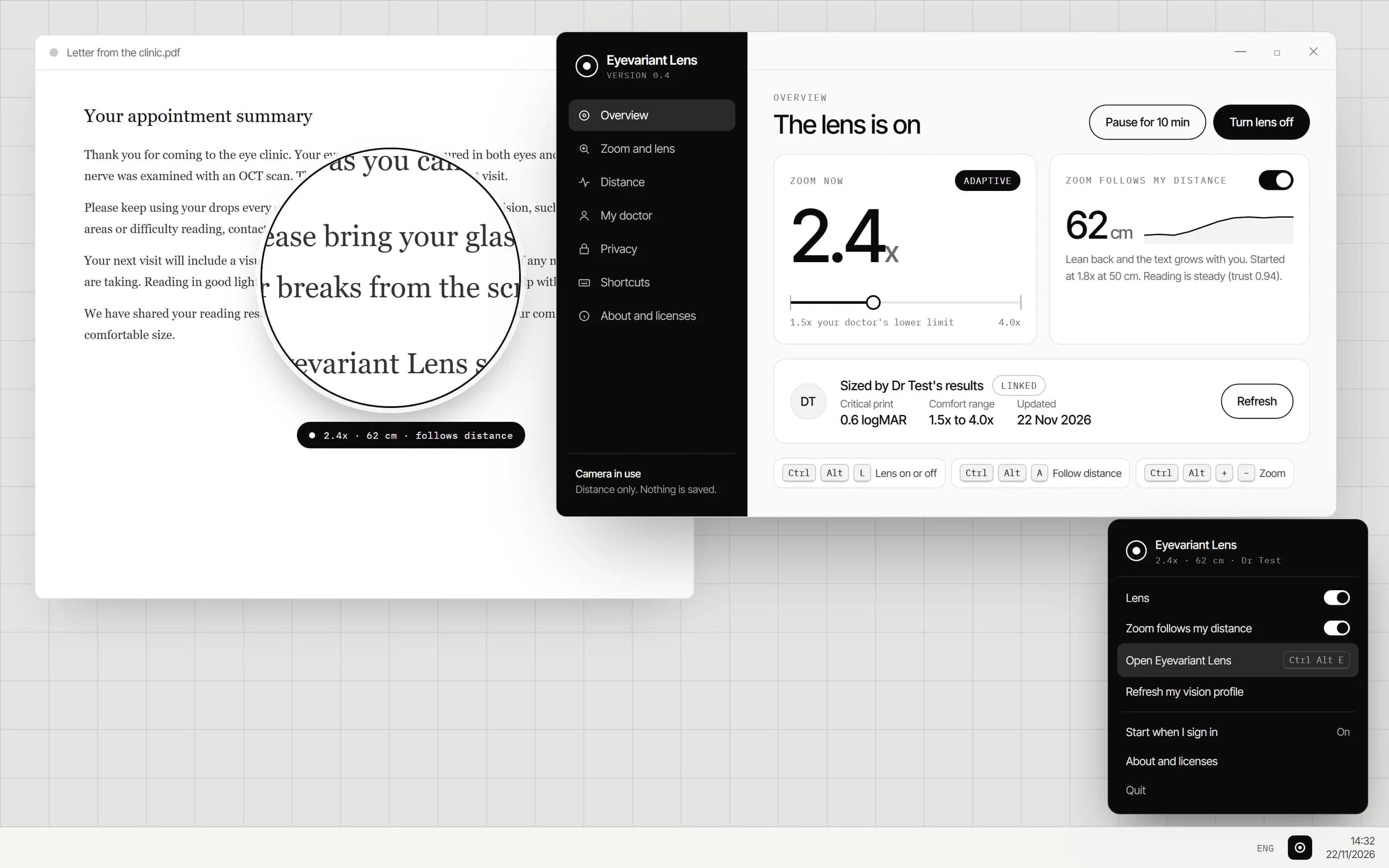
A virtual lens that follows your eyes.
Whatever you look at enlarges, sized to your prescription and your distance from the screen. No glasses to find, no settings to fiddle with.
Rx-awarezoom from your prescription±5 %distance target60 fpsgaze tracking
Scroll
Chromatic pupillometryQuantitative RAPDIris-referenced distance · 11.7 mmPost-illumination pupil response60 fps capturePersonal baseline · variance scoringEncrypted on deviceBuilt with ophthalmologistsChromatic pupillometryQuantitative RAPDIris-referenced distance · 11.7 mmPost-illumination pupil response60 fps capturePersonal baseline · variance scoringEncrypted on deviceBuilt with ophthalmologists
01 · Method
The pupil is a window on the optic nerve.
Light reaching the retina is relayed by intrinsically photosensitive retinal ganglion cells (ipRGCs) along the optic nerve to the brainstem, which constricts both pupils. When that pathway is damaged, the pupil responds later, less and more briefly. Eyevariant measures exactly that.
STEP 01
Guided setup
Room light, face distance and a steady head and device are verified before any measurement begins.
STEP 02
Calibrated flashes
Red and blue screen stimuli separate cone-driven from ipRGC-driven responses, timed to the display frame.
STEP 03
Millimetre geometry
Both pupils are fitted every frame. The iris serves as a built-in ruler for true size and distance.
STEP 04
Trend & report
Each result is compared with the patient's own baseline and delivered to the clinician as a clear report.
02 · Platform
Two products. One real-time engine.
Both run on a shared eye geometry engine that finds the face, iris and pupil, measures distance and blinks, and learns each person's baseline, all within a single frame.
Product 01 · Windows · Android
Eyevariant
Optic nerve and retinal function, measured daily. Early warning between clinic visits, objective evidence of treatment response.
Red / blue chromatic pupillometry
Left–right asymmetry (quantitative RAPD)
Strain, blink and screen-distance monitoring
Clinician dashboard and printable report
Product 02 · Windows · Android
Adaptive Gaze Lens
A virtual lens that follows your eyes. Whatever you look at enlarges, sized by your prescription and your distance from the screen.
Gaze, touch or mouse control
Zoom set by refraction and critical print size
Visual-angle constant as you move
Usage trends shared with your clinician
Shared foundation
Real-time eye geometry engine
Face & iris landmarksIris-ruler distancePupil ellipse fitBlink & eyelidGaze & vergencePersonal baselinePrivate by design
03 · Signal
Every flash produces a waveform.
Latency, amplitude, constriction velocity and the post-illumination pupil response (PIPR) are extracted from each trace and compared eye to eye, and day to day.
Pupil light reflex · blue 470 nmt = 0.0 s
Reference responseReduced ipRGC function
Extracted biomarkersOS / OD
Latencyflash onset → constriction231 ms
Amplitude(D0 − Dmin) / D038.4 %
Peak velocitymax −dD/dt4.9 mm/s
Net PIPRblue − red, at 6 s21.7 %
Asymmetrylog OD / OS0.06
04 · Conditions
If it weakens the light pathway, the pupil shows it.
Eyevariant is being developed to screen for and monitor conditions affecting the retina, optic nerve and visual pathway, beginning with glaucoma.
Primary focus
Glaucoma
Progressive retinal ganglion cell loss, often asymmetric between eyes.
Strong fit
Optic neuritis & MS
Inflammatory optic nerve injury; flare and recovery tracking.
Retinitis pigmentosa: separate rod, cone and ipRGC scores.
Good fit
Diabetic eye & autonomic neuropathy
Retinal function and pupillary autonomic trends.
Companion
Refraction, near reflex & dry eye
Photorefraction, focusing fatigue and blink analysis.
Research
AMD, concussion, neurodegeneration
Exploratory biomarkers under study.
05 · For clinicians
Your patients, measured every day. Reviewed anywhere.
A remote report built for the consulting room: per-eye biomarkers against age-matched norms, trends set against OCT and visual fields, and alerts when something changes.